
Replace a battery or a module in a modern BMW and the job isn’t done when the part is bolted in. The car’s computers still have to be told what changed. Coding is that step. Skip it and you get warning lights, a battery that dies early, or features that simply stop working, even though the hardware is brand new.
BMWs are rolling networks of computers. AAA research found that vehicles with advanced driver assistance systems can cost up to $3,000 more to repair because cameras and sensors must be recalibrated after routine work. After many BMW repairs, those systems need programming before they talk to the new part correctly.
Quick Summary: Key Takeaways
- Battery registration: A new BMW battery must be coded to the car, or the charging system overcharges and shortens its life.
- Module replacement: Swapped modules such as the FRM, EGS, or DME must be programmed to the VIN before features work.
- Warning lights: Skipping coding after a repair often leaves dash lights on despite perfectly good parts.
- Since 1979: an official Bosch service center running Autologic and Mercedes Star Diagnostic software on Northgate Boulevard.
- Right tools required: Proper BMW coding needs factory-level software, not a generic handheld code reader.
Coding tells your BMW’s computers what changed during a repair
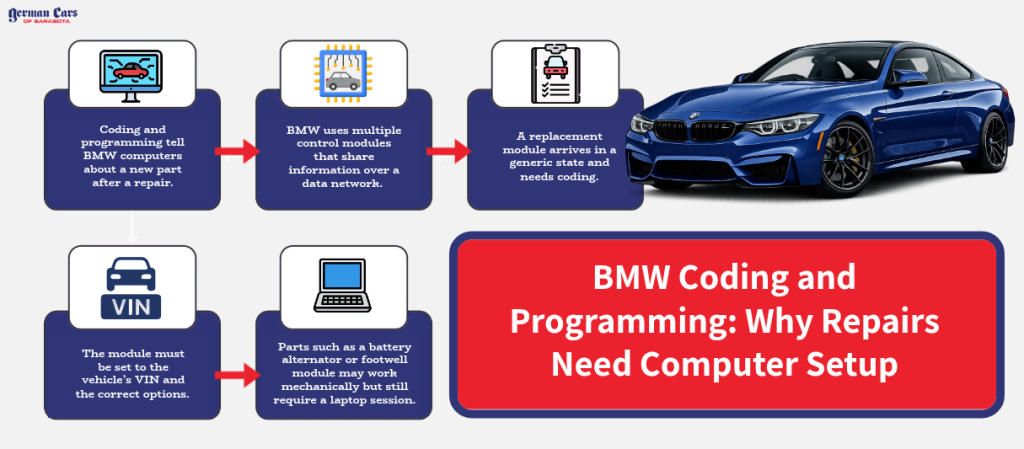
Coding and programming are how a BMW learns about a new part. Modern models run dozens of control modules, from the DME engine computer to the EGS transmission controller and the body and lighting units, all sharing information over a data network. Replace one and it arrives generic. Then it needs coding. It has to be set to your VIN with the right options before it behaves like the part that left the factory, which is why a battery, an alternator, or a footwell-module swap can look finished mechanically and still need a laptop session to actually complete the repair.
Certain repairs almost always require coding afterward
Some jobs are finished only after programming. A new battery needs registration so the smart charging system knows its type and age. A replacement module, whether it’s the FRM footwell unit, the EGS transmission controller, or a comfort-access module, must be flashed and coded to the car. Sensors are their own step. Replace a windshield or work on the suspension of a camera-equipped BMW and the driver-assist system needs a calibration, which is a different procedure from coding and worth confirming who handles before the car goes in.
Battery registration is the job people skip most
The most common coding miss we see is a new battery that was never registered. BMWs use a battery sensor and a charging strategy tuned to the exact battery, both its chemistry, lead-acid or AGM, and its age. Install a fresh one without telling the car and it keeps charging as if the old, worn battery is still in place. The result is predictable. The new battery gets overcharged, boils off capacity, and dies years early, so a $300 part fails long before it should over a five-minute coding step nobody did.
Skipping coding costs you comebacks and dead parts
Leaving coding undone is how good parts get the blame. A perfectly healthy battery dies early because it was never registered. A new module sits there with a warning light because it was never programmed to the VIN. Comebacks add up. You pay for the same part twice, chase a light no scanner will clear without the right software, and lose trust in a shop that never finished the job, all of which a proper coding session at the first visit prevents.
German Cars of Sarasota codes BMWs with factory-level tools
We’ve serviced BMWs in Sarasota since 1979, and coding is part of doing the job right. As an official Bosch service center running Autologic diagnostics, we register batteries and program replacement modules to factory specs on Northgate Boulevard. No loose ends. Whether we did the repair or you’re fixing a coding step another shop skipped, we make sure your BMW’s computers and hardware agree before it leaves, so the lights stay off and the new parts actually last.
Frequently Asked Questions
Q: Do I need to code a new BMW battery?
A: Yes. A new BMW battery must be registered to the car so the charging system matches its type and age. Skip it and the battery is overcharged and typically fails years early. It’s a quick step that protects an expensive part.
Q: Why is there a warning light after replacing a BMW part?
A: Many BMW modules must be programmed to the VIN after replacement. If that coding step is skipped, the car doesn’t recognize the new part correctly and leaves a dash light on, even though the hardware itself is fine.
Q: Can any shop do BMW programming?
A: Not really. Proper BMW coding needs factory-level software and diagnostics, not a generic code reader. A shop set up for German cars, with tools like Autologic, can register batteries and flash modules correctly.
Q: What is the difference between coding and programming a BMW?
A: Programming, or flashing, loads software onto a module, while coding sets that module’s options for your specific car and VIN. Most module replacements need both so the part matches your BMW’s exact configuration and features.
Get your BMW coded correctly in Sarasota
Had a battery or a module replaced and now something isn’t right? Bring your BMW to a Bosch-certified Sarasota shop and we’ll finish the coding the right way. Schedule an appointment online.
German Cars of Sarasota — 1535 Northgate Blvd, Sarasota, FL 34234
Hours: Mon–Thu 8:30 AM–5:00 PM; Fri 8:30 AM–4:00 PM; Sat–Sun Closed
Website: germancarsofsarasota.com